
Work Health Solutions / Medicolegal
- Work Health & Safety
- On-Site Services
- Manual Handling Training
- Computer & Office Worksite Assessments
- Ergonomic Training
- Manual Handing Risk Assessments
- Industrial Worksite Assessments
- Pre-Employment Assessments
- Medicolegal Assessments
- Independent Physiotherapy Assessments
- Return-to-Work (RTW) Plans
- Assessment & Rehabilitation
Work Health & Safety
Smart Health has a long and proud history in the work health arena, working with employers and employees to optimize health outcomes in the workplace. Our services range from individual workstation assessments, to assisting with rehabilitation and return-to-work, to providing weekly on-site assessment and treatment services.
Smart Health provides industry-leading Work Health Services to a variety of businesses across Australia. We are dedicated to combining our professional expertise & experience with cutting-edge technology to provide our clients with unique and outcome-oriented Work Health & Safety (WH&S) products.

Improving Outcomes
Industry-leading workplace health performance improves employee morale, increases productivity and delivers positive cash flows. Smart Health brings experienced, specialised Physiotherapists into your workplace to improve Work Health. Our extensive study of anatomy, biomechanics and injury allows us to develop unique workplace products. Our range of services is grounded in a very simple philosophy: applying our knowledge and expertise to your workplace to improve health outcomes.
We recognise the importance of quality to any organisation. We continually strive to provide the highest quality of service. Our assessments are independent and objective. Our treatment is personalised and thorough. Our training is worksite-specific and engaging.
On-Site Physotherapy Services
Having a physiotherapist embedded on-site delivers real advantages over off-site or ad hoc treatment models:
- Faster intervention, lower injury costs — symptoms are assessed and managed early, before they escalate into lost-time injuries or formal claims
- Less downtime — employees are treated on-site, cutting time away from the job for appointments
- Better return-to-work outcomes — direct, regular communication between the treating physiotherapist and managers means modified duties and Return To Work plans are practical and well-informed
- Faster response to reported discomfort — on-call task reviews mean concerns are addressed before they develop into injuries
- Proactive risk management — new or modified tasks are ergonomically assessed before they’re rolled out, not after an incident
- Training built for your site — manual handling and injury prevention training is designed around your actual roles and demands, not a generic template
Regular on-site physiotherapy is increasingly considered best practice in workplace injury management. .With over 20 years of experience designing and refining on-site clinics for businesses across Australia, we are perfectly positioned to take your workplace health to that next level.
If you’re looking to reduce injury costs and downtime at your workplace, get in touch to discuss an on-site program tailored to your site.
Manual Handling Training
Training programs designed and run by Smart Health work. They create change in the way workers perform their day-to-day tasks, decreasing the potential of both overuse and overload injuries. Our training programs increase awareness of how and why injuries occur and how workers can control and safely manage their daily tasks. They achieve this by being relevant, task-specific, worksite-specific and workplace-specific.
Smart Health physiotherapists attend the worksite prior to our training programs, to gain a hands-on feel for the type of work performed and the risk factors specific to each individual worksite. This allows training programs to be specifically tailored and to address the specific needs of every worksite.
Computer & Office Worksite Assessments
As employees are moving more and more towards computer-based work, the risks of sustained sitting, particularly at poorly-designed workstations, are becoming more clear. As well as the recently documented medical risk factors, organisations are noting widespread reports of postural pain through the neck and back in a majority of their workforce. Individual worksite assessments are the quickest and most effective way of ensuring that an employee’s workstation is designed as ergonomically as possible.
Taking into account the nature of the work being performed, the employee’s background, any injury history and the organisation’s budget for workstation design, a Smart Health Physiotherapist can make effective, concise recommendations regarding both the design of the workstation and the way the employee is using their computer. With these recommendations in place, postural strain is reduced, symptoms are less frequent and less severe, and employees are happier being at work.
Smart Health has been a leader in promoting and instituting sit-stand adjustable-height workstations in offices across South Australia. The evidence linking sustained sitting with poor general health outcomes (diabetes, heart disease, obesity) and musculoskeletal pain (upper back pain, neck pain and headache) continues to mount, presenting a new challenge for employers with a predominantly seated workforce. Smart Health can assist in the development of pilot programs within a business, individual sit-stand workstations, or the institution of a sit-stand program throughout an entire office. Our experience in this field over the last five years has allowed us to identify both the advantages and potential pitfalls of such programs.
Ergonomic Training
One of the biggest injury risks in the workplace is sitting in front of a computer. Poor workstation design and use can contribute to postural syndromes and repetitive strain injuries (RSIs). We use the same principles embraced in our manual handling packages to help employees stay healthy at their desks.
The training session touches on nutrition & hydration, warm-up and stretching exercises, bending & reaching patterns and most importantly, effective workstation set-up.
Manual handling principles are related to office-based tasks, such as reaching under desks and lifting copying paper. All of these principles are described from an anatomical and physiological point of view, so that employees start to understand their bodies, and can then take control of their own health.
Manual Handling Risk Assessments
Under the new WHS Regulation, the Code of Practice regarding Hazardous Manual Tasks provides a succinct screening tool to identify Hazardous Manual Tasks, and to start the process of addressing these hazards.
Smart Health physiotherapists assess these movement patterns in a working environment on a day-to-day basis, and are the best people to guide your use of these tools to create a safer workplace.
Industrial Worksite Assessments
Worksite assessments in an industrial setting are an essential ingredient in managing and mitigating risk. In an pre-emptive context, our physiotherapists can provide the ergonomic input into production, to ensure that operators are well-protected from common industrial injuries. Recommendations can range from a change in technique, to a change in production systems, to adjustment of the production process. In all cases, our physiotherapists are aware that finding cost-effective ways of looking after employees is the number one priority of any good business.
In the event that an employee does experience symptoms while performing their normal tasks, assessment of their role is crucial, to identify any movement or process that might have contributed to their symptoms. This is an essential part of best-practice Early Intervention, to ensure that the worksite is safe for other employees, and to assist an injured employee in making a successful return to work.
Pre-Employment Assessments
Why have a Pre-Employment Assessment?
Organisations and businesses are increasingly recognising the importance of matching the physical capabilities of their employees to the physical demands of their jobs. Smart Health provides a range of pre-employment assessments for a variety of businesses. These assessments have been tailored for individual worksites and roles, to test potential employees’ specific abilities, matched against specific demands.
A well-designed pre-employment assessment is an objective functional assessment of a person’s ability to perform the essential physical demands of a job. We assist employers in providing a proficient and dynamic form of pre-employment screening which systematically fulfils legal requirements. It is particularly useful for assessing an individual’s physical capabilities in relation to a specific task/job analysis, and therefore their suitability for high risk and physically demanding duties. A pre-employment screening can assist in reducing an employer’s costs associated with workplace injuries and lost time.
Medicolegal Assessments
Smart Health offers a variety of Medico Legal assessments including Independent Physiotherapy Assessments (IPA) and Worksite Assessments. These assessments rely on experienced therapists spending sufficient time with a client to gain a balanced, objective view of that client’s history, symptoms and function. Our reporting is written in easy-to-read, plain English, to allow all of those involved in a client’s management to use the results of the assessment to improve outcomes for their client. These assessments are vital in directing appropriate treatment, rehabilitation and return-to-work.
The effectiveness and power of these assessments is directly linked to the expertise and experience of the assessing therapist. Across the Smart Health team, we have a passionate group of well-respected therapists, who draw referrals from a vast variety of referrers who recognise the value of our expertise to their client.
Smart Health’s physiotherapists, profiled below, have decades of experience in functional client assessment. Our therapists possess the skills required to provide timely, accurate, objective assessments for any client.
Independent Physiotherapy Assessments
Why have an Independent Physiotherapy Assessment?
Often during the rehabilitation of an injured worker, their progress and diagnosis can become clouded by miscommunication. Our experienced Physiotherapists offer an Independent Assessment of an injured individual, reporting on the injury history, working diagnosis and recommended management. In many cases, this can mark a turning point in a rehabilitation program.
Comprehensive Clinical Assessment
Assessments will include a detailed injury history and a comprehensive clinical assessment, incorporating range of movement, compound movements, muscular strength and specific stress tests. This type of assessment can also be tailored to make specific recommendations regarding future rehabilitation, and the likely cost of such treatment approaches.
Return-to-Work (RTW) Plans
Successful return-to-work planning is a complicated combination of familiarity with an employee’s injuries, and the demands of their job. At Smart Health, many of our physiotherapists spend the majority of their working life out on the factory floor, so we’re accustomed to matching limited capacity with the physical demands of individual jobs. This expertise allows tailored, individual RTW planning, to assist employees back into the workforce as soon as possible, maintaining work hardening while protecting against any aggravation.
Assessments and Rehabilitation
In a work health setting, rehabilitating injured workers is one of the biggest challenges facing an organisation. Success in rehabilitation and return-to-work requires accurate diagnosis, effective treatment, the selection of appropriate duties and targeted exercise. Vital to this process is effective communication between an injured employee, treating therapists and on-site rehabilitation staff. This communication ensures that all parties are aware of the goals of the rehabilitation program and their responsibilities within that structure.
Smart Health has built a team of expert therapists, many of whom have specialised in working with business, as well as injured employees. Our goals are:
- to optimise return-to-work outcomes,
- accurate assessment and diagnosis,
- expert treatment,
- specific exercise programs and
- regular liaison with the workplace to ensure a smooth return-to-work process.
Our team treats workplace injuries, assesses capacity and designs exercise programs every day. This is done both from our clinic at Keswick and at individual worksites. We provide these services for dozens of businesses across the state, across a variety of industries.
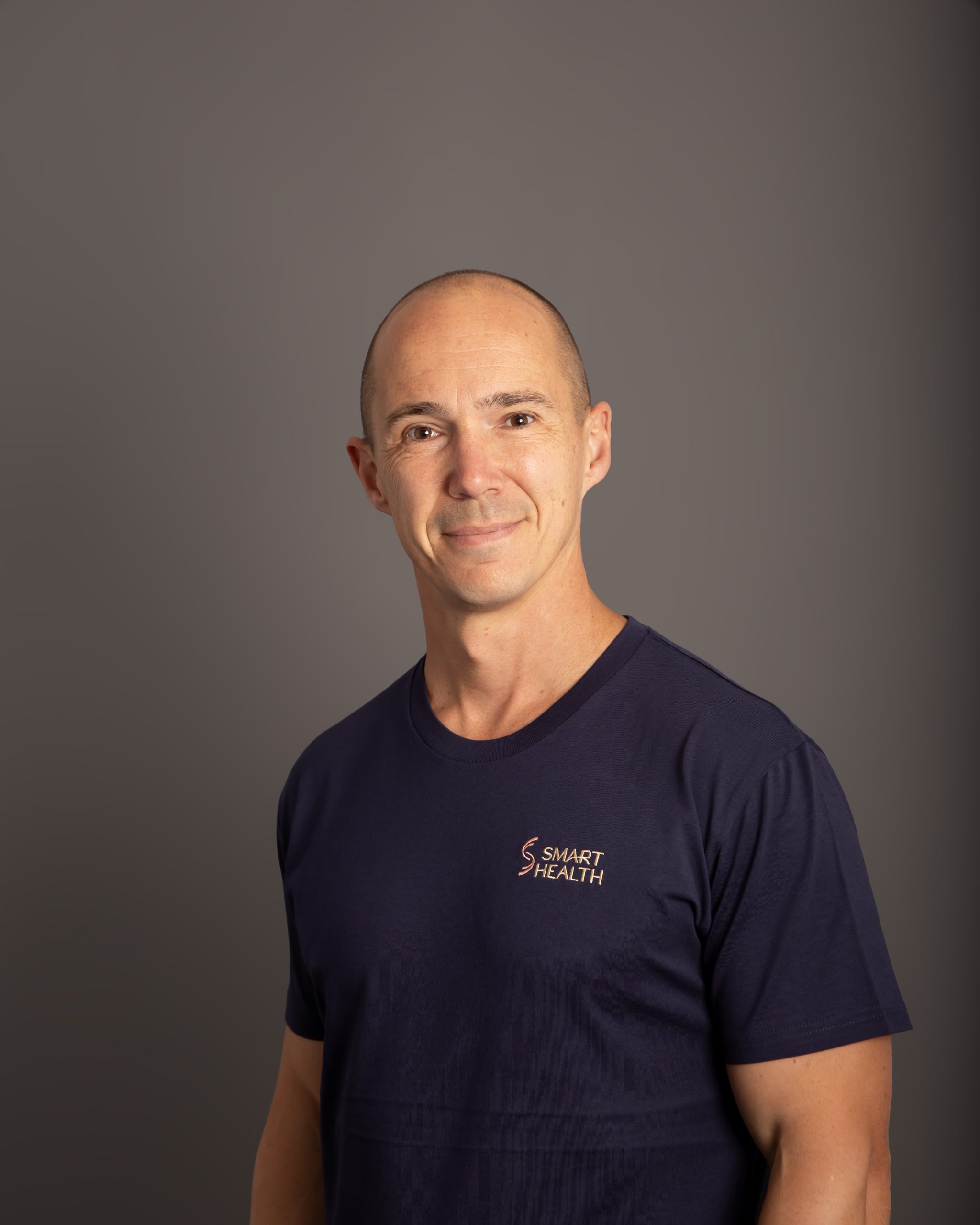
Meet Our Work Health Solutions Practitioner
Contact Us Today
Your time is always respected. You’ll never feel rushed and have all your questions answered. Contact us today to schedule your first appointment!